Saturday, November 10, 2012

Tuesday, October 30, 2012
Intel Core i7-4900 Series Arrives in Q3-2013, i7-3970X Around the Corner: Report
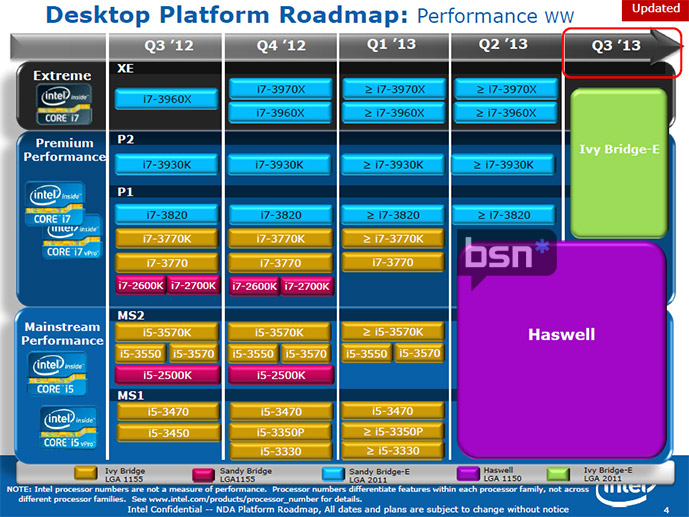
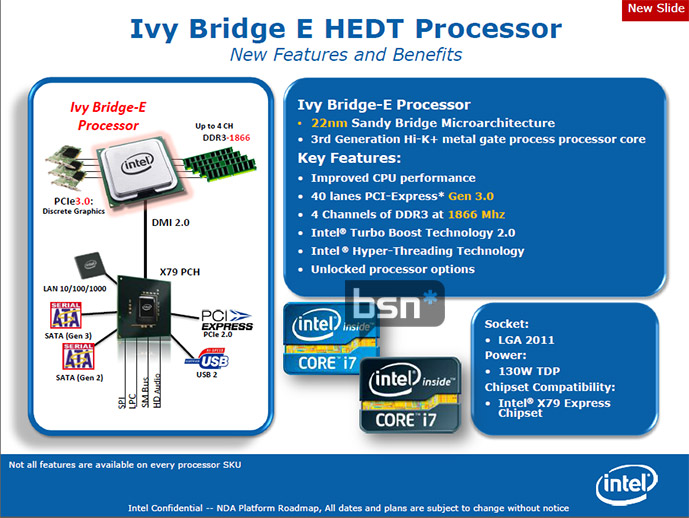
The fastest client computing platform, Sandy Bridge-E, won't be seeing successors for a long time now, according to a Bright Side of News report. The next-generation "Ivy Bridge-E" lineup, which will carry processor model number series Core i7-49xx, aren't due until the third quarter of 2013. Ivy Bridge-E will build on the existing Sandy Bridge-E HEDT platform with Intel X79 Express chipset. Existing LGA2011 motherboards will be able to run the i7-4900 series chips with BIOS updates.
Meanwhile, the closest addition to Intel's socket LGA2011 Core i7-3900 series is the Core i7-3970X, which displaces the Core i7-3960X from the top spot. This chip will hit the shelves in a few weeks' time. According to a leaked specs sheet, the i7-3970X ships with a nominal clock speed of 3.50 GHz, with maximum Turbo Boost speed of 4.00 GHz. The specs sheet also confirms that i7-3970X will be a six-core chip, with HyperThreading enabling 12 logical CPUs, allaying rumors that Intel will unlock two additional cores and the full 20 MB L3 cache on the Sandy Bridge-E silicon, making it an eight-core chip.


Meanwhile, the closest addition to Intel's socket LGA2011 Core i7-3900 series is the Core i7-3970X, which displaces the Core i7-3960X from the top spot. This chip will hit the shelves in a few weeks' time. According to a leaked specs sheet, the i7-3970X ships with a nominal clock speed of 3.50 GHz, with maximum Turbo Boost speed of 4.00 GHz. The specs sheet also confirms that i7-3970X will be a six-core chip, with HyperThreading enabling 12 logical CPUs, allaying rumors that Intel will unlock two additional cores and the full 20 MB L3 cache on the Sandy Bridge-E silicon, making it an eight-core chip.

Tuesday, October 9, 2012
SSH login without password
SSH login without password
http://linuxproblem.org/art_9.
Your aim
You want to use Linux and OpenSSH to automize your tasks. Therefore you need an automatic login from host A / user a to Host B / user b. You don't want to enter any passwords, because you want to call ssh from a within a shell script.
How to do it
First log in on A as user a and generate a pair of authentication keys. Do not enter a passphrase:
a@A:~> ssh-keygen -t rsa
Generating public/private rsa key pair.
Enter file in which to save the key (/home/a/.ssh/id_rsa):
Created directory '/home/a/.ssh'.
Enter passphrase (empty for no passphrase):

Enter same passphrase again:
Your identification has been saved in /home/a/.ssh/id_rsa.
Your public key has been saved in /home/a/.ssh/id_rsa.pub.
The key fingerprint is:
3e:4f:05:79:3a:9f:96:7c:3b:ad:e9:58:37:bc:37:e4 a@A
Now use ssh to create a directory ~/.ssh as user b on B. (The directory may already exist, which is fine):
a@A:~> ssh b@B mkdir -p .ssh
b@B's password:
Finally append a's new public key to b@B:.ssh/authorized_keys and enter b's password one last time:
a@A:~> cat .ssh/id_rsa.pub | ssh b@B 'cat >> .ssh/authorized_keys'
b@B's password:
From now on you can log into B as b from A as a without password:
a@A:~> ssh b@B hostname
B
A note from one of our readers: Depending on your version of SSH you might also have to do the following changes:
- Put the public key in .ssh/authorized_keys2
- Change the permissions of .ssh to 700
- Change the permissions of .ssh/authorized_keys2 to 640
Wednesday, October 3, 2012
Ahead Of First Debate, NPR Poll Shows Romney Within Striking Distance
I found the following story on the NPR iPhone App:
Ahead Of First Debate, NPR Poll Shows Romney Within Striking Distance
by Mara Liasson
NPR - October 3, 2012
The latest poll by NPR and its bipartisan polling team [pdf] shows President Obama with a 7-point lead among likely voters nationally and a nearly identical lead of 6 points in the dozen battleground states where both campaigns are spending most of their time and money....
http://www.npr.org/blogs/itsallpolitics/2012/10/03/162171197/on-eve-of-first-debate-npr-poll-shows-romney-within-striking-distance?sc=17&f=1001
Monday, October 1, 2012
MATLAB CUDA
Installing CUDA Toolkit 4.2 on Ubuntu 11.04 Linux
Expectation Maximization of Gaussian Mixture Models via CUDA
http://www.mathworks.com/matlabcentral/fileexchange/24020-expectation-maximization-of-gaussian-mixture-models-via-cuda
Friday, September 21, 2012
Failure of update the tool of WEKA
Failure of update the tool of WEKA
Question: How to solve the following question:
java.io.IOException: Server returned HTTP response code: 500 for URL: http://weka.sourceforge.net/packageMetaData/WekaODF/versions.txt
Answer:
create a file called "PackageRepository.props" in $HOME/wekafiles/props
and add the following line to it:

weka.core.wekaPackageRepositoryURL=http://www.cs.waikato.ac.nz/ml/weka/packageMe
Source:
https://list.scms.waikato.ac.nz/pipermail/wekalist/2012-February.txt
Thursday, September 20, 2012
Perl script to covert libsvm data format into WEKA ARFF format
#!/usr/bin/perl
# perl lsvm2arff.pl inputLibSVMData.lsvm outputWeka.arff
$attNum=`head -n1 $ARGV[0] | wc -w`;
$attNum=$attNum-1;
$cmd_str="cat $ARGV[0] | perl -lane 'print \$F[0]' | sort | uniq | sort -n";
chomp($IDs=`$cmd_str`);
@classIDs=split(' ',$IDs);
#print "IDS=@classIDs, $classIDs[0]\n";
print "In this convertion code, your original class 'label' will be converted into 'class_label'; \nFor example, if class IDs are:\t1,\t\t2; \nthey will be converted into:\tclass_1,\tclass_2\n";
open(OUT, ">$ARGV[1]") || die "$!";
print OUT "\@relation libSVM2ARFF_DATA\n";
print OUT "\n";
for($i=1;$i<=$attNum;$i++){
print OUT "\@attribute attribute_${i} real\n";
}
$tmp_str="";
for($j=0;$j<@classIDs-1;$j++){
$ID=$classIDs[$j];
$tmp_str=$tmp_str."class_$ID,";
}
print OUT "\@attribute class {${tmp_str}class_$classIDs[-1]}\n";
print OUT "\n";
print OUT "\@data\n";
#print "$cmd_str\n";
#$cmd_str="cat ~/Dropbox/tmp/tst_data_D50.lsvm | perl -lane 's|\d+:||g; print \$_' | perl -lane '\$str="";for(\$i=1;\$i<\@F;\$i++){\$str=\$str."\$F[\$i],"};print "${str}class$F[0]"'"
$cmd_str="cat $ARGV[0] | perl -lane 's|\\d+:||g; print \$_' | perl -lane '\$len=\@F; \$str=\"\";for(\$i=1;\$i<\$len;\$i++){\$str=\$str.\"\$F[\$i],\"};print \"\${str}class_\$F[0]\"'";
#print "$cmd_str\n";
#`echo $cmd_str`;
chomp(@data=`$cmd_str`);
foreach(@data){
print OUT "$_\n";
}
close(OUT);
Subscribe to:
Posts (Atom)